Conocimiento Base
Explore consultas comunes sobre la resina de poliéster
General Purpose Polyester Resin (commonly abbreviated as GP resin or Ortho GP resin) is the most widely produced and sold type of unsaturated polyester resin globally. It is the standard, entry-level commercial resin formulated with orthophthalic acid (hence also called orthophthalic resin or ortho resin) as a key raw material.
Why GP Resin Dominates the Market
- Lowest Cost: Orthophthalic acid (OPA) is the most economical of the dicarboxylic acids used in resin synthesis. GP resin is therefore the most affordable commercial resin available.
- Ease of Use: GP resin has well-understood, predictable handling characteristics. It wets out glass fibers efficiently and cures readily at room temperature with standard MEKP catalyst systems.
- Wide Availability: It is produced in large quantities by manufacturers worldwide, ensuring consistent supply and competitive pricing.
- Good General Mechanical Properties: For non-critical structural applications, GP resin provides adequate tensile strength, flexural modulus, and hardness.
Limitations of GP Resin
- Lower Water Resistance: Ortho resin absorbs more water over time compared to iso and vinyl ester resins, making it unsuitable for continuous water immersion (marine below-waterline use).
- Lower Chemical Resistance: Not recommended for contact with acids, alkalis, or solvents in industrial chemical environments.
- Higher Shrinkage: Compared to iso resins, ortho resins typically shrink slightly more during cure.
Ideal Applications for GP Resin
FRP panels for construction and roofing, automotive body filler (topcoat resin), non-structural decorative items, furniture, laminating above-waterline marine components, and general workshop fabrication projects.
Osmotic blistering is one of the most feared problems in fiberglass boat construction. It occurs when water molecules slowly permeate through the gelcoat and into the fiberglass laminate, where they dissolve water-soluble compounds, creating an osmotic pressure differential that draws in more water. Over time, this pressure is sufficient to form blisters between the gelcoat and the laminate.
Why Does Blistering Happen?
The primary culprits are:
- The inherently moderate water permeability of standard orthophthalic polyester resin
- Water-soluble compounds present in the cured resin (residual glycols, acids from incomplete cure)
- Micro-voids and air inclusions in the laminate that act as water collection points
The Vinyl Ester Barrier Coat Solution
A vinyl ester barrier coat works on two principles:
- Low Water Permeability: Vinyl ester resins, by their molecular structure, are significantly less permeable to water than polyester resins. The epoxy backbone of vinyl ester creates a much denser, more hydrophobic molecular network.
- Chemical Purity: Vinyl ester formulations contain far fewer water-soluble by-products than polyester, removing the osmotic driving force even if small amounts of water do penetrate.
Application Protocol
For maximum blister protection on a new boat hull:
- Apply the ISO-NPG gelcoat as the outermost decorative layer
- Apply 2 to 3 layers of vinyl ester resin laminate immediately behind the gelcoat as a dedicated barrier laminate
- Complete the structural hull laminate with isophthalic polyester
For blister repair on existing hulls, the gelcoat and compromised laminate are removed, the hull is dried thoroughly, and then new vinyl ester layers are applied as a protective barrier before re-gelcoating.
Vacuum bagging is an intermediate composite manufacturing technique that dramatically improves the quality of hand-laid laminates by applying atmospheric pressure uniformly to the wet laminate during cure. It bridges the gap between basic open-mold hand lay-up and fully closed-mold processes like RTM.
The Vacuum Bagging Process
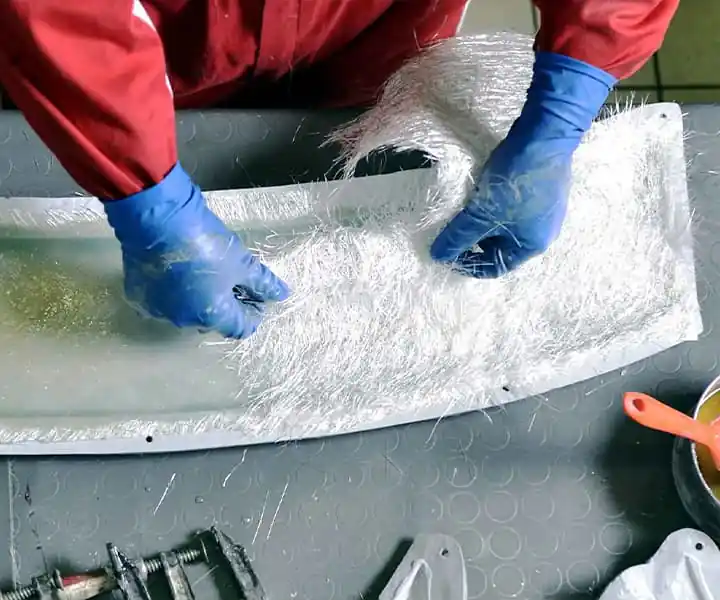
- Standard Lamination: The laminate is laid up in the mold using the conventional hand lay-up or wet lay-up method.
- Release Film: A perforated or non-perforated peel ply release film is placed over the wet laminate.
- Breather / Bleeder Fabric: An absorbent breather fabric is placed over the release film to absorb excess resin and distribute vacuum pressure evenly across the bag.
- Vacuum Bag: A flexible nylon or polyethylene film is placed over everything and sealed to the mold flange with sealant tape.
- Aplicación de vacío: A vacuum pump creates negative pressure inside the bag (typically 0.8 to 1.0 bar). Atmospheric pressure then pushes down on the bag from the outside.
- Cure: The laminate cures under sustained vacuum pressure.
Benefits Over Standard Hand Lay-Up
- Higher Fiber Volume Fraction: The pressure consolidates the laminate, squeezing out excess resin and increasing glass-to-resin ratio from ~30:70 to ~45:55.
- Fewer Voids: Vacuum pressure removes entrapped air and volatile gases, producing a denser, void-free laminate.
- Better Mechanical Properties: The higher fiber fraction directly translates to improved strength and stiffness in the finished part.
- Reduced Styrene Emissions: The sealed bag significantly reduces open-air styrene evaporation, improving shop safety.
Selecting the right resin supplier is a strategic business decision that directly impacts your product quality, production reliability, and long-term profitability. For B2B buyers sourcing industrial volumes of thermosetting resins, the following criteria provide a rigorous evaluation framework.
1. Technical Capability and R&D Support
A qualified resin supplier should have in-house technical chemists who can help you select the right resin grade, troubleshoot processing problems, and develop custom formulations if needed. Ask for evidence of their quality management system (ISO 9001 certification is the baseline standard).
2. Consistent Product Quality
Batch-to-batch consistency is essential. Minor variations in resin reactivity, viscosity, or acid value can disrupt your production schedules and lead to rejected parts. Request Certificates of Analysis (CoA) for recent production batches and verify that key parameters fall within tight specification limits.
3. Supply Chain Reliability
Evaluate the supplier’s raw material sourcing strategy. Do they have diversified feedstock suppliers to avoid single points of failure? What is their typical lead time and minimum order quantity (MOQ)? Do they hold strategic inventory to buffer against supply disruptions?
4. Regulatory Compliance
Ensure the supplier provides up-to-date Safety Data Sheets (SDS / MSDS). For resins sold into Europe, they must comply with REACH regulations. For food-contact applications, relevant food safety certifications are mandatory.
5. Logistics and Packaging
Resins are hazardous materials (typically Packing Group III flammable liquids). Verify that the supplier has experience with international hazardous goods shipping (IMDG, IATA regulations) and can provide appropriate packaging: drums, IBC totes, or bulk tank containers depending on your volume needs.
6. Pricing and Payment Terms
Get quotes from at least three suppliers. Beyond the unit price, evaluate total landed cost including freight, duties, and payment terms. Reliable long-term suppliers often offer better pricing flexibility in exchange for volume commitments.
A composite sandwich structure is a three-layer construction: two thin, stiff, and strong composite facing skins bonded to a lightweight core material in between. The result is a structural panel that achieves extremely high stiffness and bending strength at a very low overall weight.
How It Works (The I-Beam Principle)
The engineering principle is similar to an I-beam: most of a beam’s bending resistance comes from material located far from the neutral axis (the flanges), while the web simply keeps them apart. In a sandwich panel, the face skins act as the flanges (carrying tensile and compressive stress), while the core acts as the web (carrying shear loads and maintaining the separation between the skins).
Common Core Materials
- PVC Foam (e.g., Divinycell): The most common marine and wind energy core. Excellent balance of stiffness, strength, and water resistance.
- PET Foam: A recyclable, cost-effective alternative to PVC foam with good mechanical properties.
- Balsa Wood: A natural core material with very high compressive strength. Widely used in wind turbine blades and marine applications.
- Honeycomb (Nomex or aluminum): Aerospace-grade core material providing the highest stiffness-to-weight ratio of any core type.
- Syntactic Foam: Used in deep-sea applications due to its hydrostatic pressure resistance.
Skin Materials
The face skins are typically fiberglass (GFRP) or carbon fiber reinforced polymer (CFRP) laminates, infused or laminated with epoxy or vinyl ester resin.
Aplicaciones
Wind turbine blades, boat hulls and decks, high-speed rail interior panels, truck body side panels, aerospace flooring, and architectural cladding.
GPPS (General Purpose Polystyrene) is a rigid, transparent thermoplastic polymer produced by the polymerization of styrene monomer. It is one of the most widely produced plastics in the world, valued for its clarity, stiffness, and excellent processability.
Key Properties of GPPS
- Optical Clarity: GPPS is water-clear with light transmission up to 90%, making it a cost-effective alternative to glass and acrylic for transparent packaging and display applications.
- High Stiffness: It has excellent rigidity at room temperature, maintaining dimensional accuracy in molded parts.
- Good Electrical Insulation: GPPS is a reliable electrical insulator for electronic components and housings.
- Easy Processability: It melts and flows easily in injection molding and extrusion processes, allowing fast cycle times and complex part geometries.
- Food Contact Approval: Food-grade GPPS grades are approved for use in food packaging when formulated without harmful additives.
Limitations
- Brittle: GPPS is notch-sensitive and cracks easily under impact. HIPS (High Impact Polystyrene) is the toughened alternative for applications requiring better impact resistance.
- Poor UV Resistance: Unmodified GPPS yellows and becomes brittle under prolonged UV exposure. UV stabilizers must be added for outdoor applications.
- Limited Chemical Resistance: Dissolves in many organic solvents including acetone and toluene.
Common Applications
Clear food containers (yogurt cups, deli containers), disposable cutlery and plates, CD and DVD cases, medical devices, laboratory petri dishes, model kits, display packaging, and electrical component housings.
FRP grating (Fiberglass Reinforced Plastic grating) is a composite structural product used as floor panels, walkways, platforms, and drainage covers in industrial, marine, and civil infrastructure environments. It is manufactured using either a molded (cast in one piece) or pultruded (assembled from individual pultruded members) process.
Types of FRP Grating
- Molded FRP Grating: Made by placing glass fiber rovings in a grid pattern inside a mold, then filling with resin. The result is a one-piece panel with equal strength in both directions. Available in square, rectangular, and diamond mesh patterns.
- Pultruded FRP Grating: Individual I-bars or T-bars produced by pultrusion are mechanically fastened together. Provides higher load capacity in one direction (the bearing bar direction).
FRP vs Steel Bar Grating: Key Comparisons
- Resistencia a la corrosión: FRP is completely immune to rust and corrosion. Steel grating in chemical plants or coastal environments requires expensive painting and replacement. FRP needs neither.
- Weight: FRP grating is approximately 70-80% lighter than equivalent steel grating. This reduces structural load on supports, and dramatically lowers installation labor costs.
- Safety: FRP is inherently non-conductive (important near electrical equipment) and can be manufactured with anti-slip grit surfaces for safe footing in wet conditions.
- Low Maintenance: No painting, no galvanizing, no rust treatment. FRP grating is essentially maintenance-free over its lifespan.
- Cost: FRP grating typically has a higher initial purchase cost than carbon steel grating, but its total lifecycle cost is significantly lower when maintenance, replacement, and installation are factored in.
A thixotropic resin is a resin whose viscosity changes in response to shear force. At rest, it behaves like a thick gel. When stirred or applied with a brush, the shear force temporarily reduces its viscosity, making it flow. Once the agitation stops, it thickens up again almost immediately.
Why is Thixotropy Needed?
Standard (non-thixotropic) resins are low-viscosity liquids. When applied to a vertical or overhead mold surface, gravity causes them to drain away from the surface before they can gel and cure. This is unacceptable for quality lamination.
A thixotropic resin, by contrast, holds its position on vertical surfaces after application. The shear applied by a brush or roller temporarily liquefies it enough to spread and saturate fibers, but it then thickens back up and remains in place on the vertical wall.
Common Thickening Agents
- Fumed Silica (Aerosil): The most common thixotrope. Nano-scale silica particles form a hydrogen-bonded network in the resin that provides the gel-like structure at rest.
- Organoclays (Bentone): Clay-based thixotropes used in some specialty resin systems.
Aplicaciones
Thixotropic resins are essential for: repair work on existing structures, laminating the hull sides and decks of boats, applying gelcoat and laminate to vertical mold surfaces, and any application where the resin must not sag or drain before it gels.
Artificial stone resin (also called engineered stone resin or quartz stone resin) is a special-purpose unsaturated polyester resin used as the binder matrix in the production of man-made stone surfaces. Products like quartz countertops, acrylic solid surface sheets, and cultured marble are all manufactured using this technology.
Composition of Engineered Stone
A typical quartz stone slab consists of:
- 93-95% Natural Minerals: Ground quartz, silica, marble, or granite aggregates provide the hardness, density, and natural stone appearance.
- 5-7% Polymer Resin Binder: A specialized unsaturated polyester or methyl methacrylate (MMA) resin binds the mineral particles together. This resin determines the slab’s flexibility, color consistency, and resistance to staining.
- Pigments: Inorganic pigments are added to achieve the desired color and veining pattern.
The Manufacturing Process
- Mineral aggregates and resin binder are precisely weighed and mixed together in industrial blenders.
- The mixture is spread into flat molds at the desired slab thickness (typically 20mm or 30mm).
- The filled mold is placed into a vibro-compression press, which simultaneously compacts the mixture under vacuum (to remove air) and vibration (to ensure dense, uniform packing).
- The compacted slab is then cured in a heated kiln.
- The cured slab is ground, polished, and inspected before cutting to customer dimensions.
Why Resin Quality Matters
The resin binder directly influences the final slab quality. A high-performance artificial stone resin provides excellent adhesion to mineral fillers, low shrinkage during cure, high transparency (to preserve natural mineral color), and resistance to yellowing under UV exposure.
Resin casting is the process of pouring liquid resin into a mold to create solid objects such as decorative pieces, functional prototypes, jewelry, figurines, and industrial parts. It is one of the most accessible composite manufacturing techniques for both hobbyists and professionals.
Types of Casting Resin
- Clear Polyester Casting Resin: Excellent optical clarity, very low cost. Ideal for embedding objects (flowers, insects), making paperweights, and decorative items. Has a noticeable styrene odor and moderate shrinkage.
- Epoxy Casting Resin: Crystal clear with virtually no shrinkage. Produces premium-quality castings with excellent UV stability (when UV-stabilized formulations are used). More expensive and slower curing than polyester.
- Polyurethane Casting Resin: Fast-curing with excellent dimensional accuracy. Available in rigid, semi-rigid, and flexible formulations. Ideal for rapid prototyping and production casting of functional parts.
Essential Equipment
- Silicone molds (flexible, reusable, and provide excellent release)
- Digital scale (for accurate resin-to-hardener ratio measurement)
- Mixing cups and stir sticks
- Vacuum chamber or pressure pot (to eliminate air bubbles)
- Mold release spray (for non-silicone molds)
Tips for Bubble-Free Castings
- Mix resin slowly and deliberately to minimize air entrainment
- Pour resin in a thin stream from a height to break surface tension
- Use a heat gun or torch to pop surface bubbles immediately after pouring
- For critical parts, degas the mixed resin in a vacuum chamber before pouring
Marine environments present some of the harshest conditions any material can face: constant water immersion, UV exposure, thermal cycling, and mechanical stress from wave impact. Choosing the right resin for boat building is critical to ensure a long-lasting, blister-free hull.
Resin Options for Marine Use (Ranked by Performance)
1. Isophthalic-NPG Polyester Resin (Best Value for Marine)
This is the industry-standard marine-grade resin. The neopentyl glycol (NPG) in the molecular chain provides exceptional resistance to water absorption (hydrolysis), which is the root cause of hull osmotic blistering. All reputable boatbuilders use ISO-NPG resin for at minimum the hull barrier coat and gelcoat.
2. Vinyl Ester Resin (Premium Marine Protection)
Vinyl ester provides the best osmotic blister resistance of all polyester-family resins. It is commonly applied as a dedicated barrier coat (2-3 layers behind the gelcoat) or used throughout the entire hull laminate in high-end marine construction. It also provides superior impact resistance (toughness) compared to polyester.
3. Epoxy Resin (Highest Performance)
Epoxy offers the absolute best adhesion, water resistance, and mechanical properties. It is the preferred resin for wooden boat building (encapsulation), high-performance racing sailboats, and repair work. However, it is the most expensive option and is more sensitive to mixing ratios.
4. Orthophthalic Polyester (Not Recommended for Below-Waterline)
Standard ortho resin has relatively poor water resistance and should not be used for any part of the hull that will be permanently immersed. It is suitable only for above-waterline structures like decks and cabin interiors.
Key Recommendations
- Always use an ISO-NPG gelcoat as the first defense layer
- Apply 2-3 layers of vinyl ester barrier coat behind the gelcoat
- Use isophthalic polyester for the structural laminate layers
- Never use ortho resin below the waterline
When building a fiberglass composite, the reinforcement is just as important as the resin. The two most common forms of glass fiber reinforcement are Chopped Strand Mat (CSM) y Woven Roving (WR). Each serves a distinct purpose in the laminate structure.
Chopped Strand Mat (CSM)
CSM consists of randomly oriented short glass fiber strands (typically 50mm long) held together by a chemical binder. It is available in various areal weights from 225 g/m2 to 900 g/m2.
- Strengths: Conforms easily to complex shapes. Provides equal strength in all directions (isotropic). Creates a smooth, resin-rich surface layer. Low cost.
- Limitations: Lower mechanical strength than woven reinforcements. Higher resin consumption (typical glass-to-resin ratio is 30:70 by weight).
- Best For: First layer behind gelcoat (print-through prevention), complex mold shapes, general-purpose laminating, and corrosion barrier layers in chemical equipment.
Woven Roving (WR)
WR consists of heavy bundles (rovings) of continuous glass fibers woven into a coarse fabric. Standard weights range from 400 g/m2 to 800 g/m2.
- Strengths: Much higher mechanical strength and stiffness. Excellent glass-to-resin ratio (50:50 or higher). Builds thickness quickly.
- Limitations: Does not conform well to tight curves. Can print through a thin gelcoat layer. More expensive per square meter.
- Best For: Structural layers where maximum strength is needed (boat hulls, tanks, structural beams).
The Ideal Laminate Schedule
Professional laminators typically alternate layers: CSM behind the gelcoat (for surface quality), then alternating WR and CSM layers. The CSM between woven layers provides interlaminar bonding and prevents delamination.
Fire retardant resins are specially formulated thermosetting resins designed to resist ignition, slow flame spread, and reduce smoke generation when exposed to fire. In many building, transportation, and public infrastructure applications, the use of fire retardant composites is not optional – it is mandated by safety codes and regulations.
How Fire Retardancy Is Achieved
- Halogenated Systems: Bromine or chlorine-containing additives are blended into the resin. When exposed to flame, they release halogen radicals that interrupt the combustion chain reaction. These are effective but face increasing environmental scrutiny.
- Alumina Trihydrate (ATH) Fillers: ATH is an inorganic mineral filler added at high loadings (often 100-200 phr). When heated, ATH releases water vapor, which cools the flame front and dilutes flammable gases. It is halogen-free and non-toxic.
- Phosphorus-Based Additives: Phosphorus compounds promote char formation on the resin surface, creating an insulating barrier that shields the underlying material from heat and oxygen.
- Inherently FR Resins: Some resins, such as phenolic and certain modified polyester formulations, possess inherent flame resistance in their molecular structure without the need for additives.
Key Fire Test Standards
- ASTM E84 (Surface Burning Characteristics): Measures flame spread index and smoke developed index.
- UL 94: Vertical and horizontal burn tests classifying materials from V-0 (self-extinguishing) to HB (slow burn).
- BS 476: British standard for fire tests on building materials and structures.
- EN 13501-1: European classification of fire performance for construction products.
Aplicaciones
Public transportation panels (trains, buses), building cladding and roofing, tunnel linings, offshore platform structures, and electrical enclosures.
En spray-up process (also called spray lay-up or chop spray) is an open-mold composite manufacturing method that is faster and more automated than the traditional hand lay-up method. It uses a specialized chopper gun to simultaneously spray resin and chopped glass fibers onto a mold surface.
How the Spray-Up Process Works
- Mold Preparation: The mold is cleaned and coated with a release agent, followed by a gelcoat layer (applied by spray).
- Spray Application: A chopper gun is used, which performs two functions simultaneously: it chops continuous glass fiber roving into short strands (typically 25-50mm) and atomizes catalyzed polyester resin. Both the chopped fibers and resin are sprayed together onto the mold surface.
- Rolling / Consolidation: A worker uses a metal or mohair roller to compact the sprayed material, removing trapped air and ensuring thorough fiber wet-out.
- Build-Up and Cure: Multiple passes build the laminate to the desired thickness. The part then cures at ambient temperature.
Advantages Over Hand Lay-Up
- Significantly faster deposition rates (up to 5 kg/min of composite)
- Lower labor cost per part for large, simple shapes
- No need for pre-cut reinforcement patterns
Typical Products
Bathtubs, shower stalls, swimming pools, boat hulls, truck body panels, large storage tanks, and architectural elements.
The price of unsaturated polyester resin (UPR) is not fixed and fluctuates based on several interconnected raw material, manufacturing, and logistics factors. Understanding these variables helps buyers make informed purchasing decisions and negotiate better contracts.
Key Price Drivers
- Raw Material Costs: UPR is synthesized from petrochemical feedstocks. The prices of propylene glycol, maleic anhydride, phthalic anhydride, and styrene monomer are directly tied to crude oil and natural gas prices. Any volatility in the energy market ripples through resin pricing.
- Resin Grade: General purpose (ortho) resins are the most affordable. Isophthalic resins cost more due to the higher price of isophthalic acid. Vinyl ester resins are more expensive still, reflecting the cost of the epoxy backbone.
- Order Volume: Bulk purchases (full truckloads of 20 metric tons or more) command significantly lower per-kilogram pricing than small drum orders.
- Logistics and Freight: Resin is a heavy, hazardous liquid cargo. Shipping costs – especially international ocean freight from manufacturing hubs in China, India, or the Middle East – form a substantial part of the landed cost.
- Currency Exchange Rates: For international buyers, fluctuations in exchange rates against USD or CNY can add 5-10% variability to the final cost.
Typical Price Ranges (Reference Only)
As a general guideline (prices fluctuate with market conditions):
- Ortho GP Resin: USD 1.20 – 1.80 per kg (FOB China)
- Isophthalic Resin: USD 1.50 – 2.20 per kg
- Resina de éster vinílico: USD 2.50 – 4.50 per kg
For an accurate and competitive quotation tailored to your specific project requirements, contact Alita Resins directly. We offer factory-direct pricing with flexible packaging and logistics solutions.